Enterprise Networking in the Philippines: Cisco, Fortinet, and HPE Aruba Compared
For most Philippine businesses, "networking" means the switch in the server room and the Wi-Fi on the office floor. For enterprises that have grown past the point where a consumer router and a 24-port unmanaged switch are adequate, the decision becomes more consequential — and more expensive to get wrong.
Three vendors dominate enterprise networking procurement in the Philippines: Cisco, Fortinet, and HPE Aruba. All three are available through certified local channel partners. All three serve the same core requirement — connecting devices, managing traffic, securing the perimeter. The differences are in architecture, management model, cost structure, and operational overhead.
Cisco: The Incumbent Standard
Cisco's switching and wireless portfolio — Catalyst for enterprise, Meraki for cloud-managed environments — remains the most widely deployed enterprise networking platform in the Philippines. In large BPO campuses, banking network operations centers, and government agency infrastructure, Cisco is the default assumption.
What Cisco does well:
- Breadth and depth. Cisco's portfolio covers every layer: access switching, core routing, data center fabric, wireless, and SD-WAN. If your environment is large enough to justify specialised hardware at each tier, Cisco has a validated architecture for it.
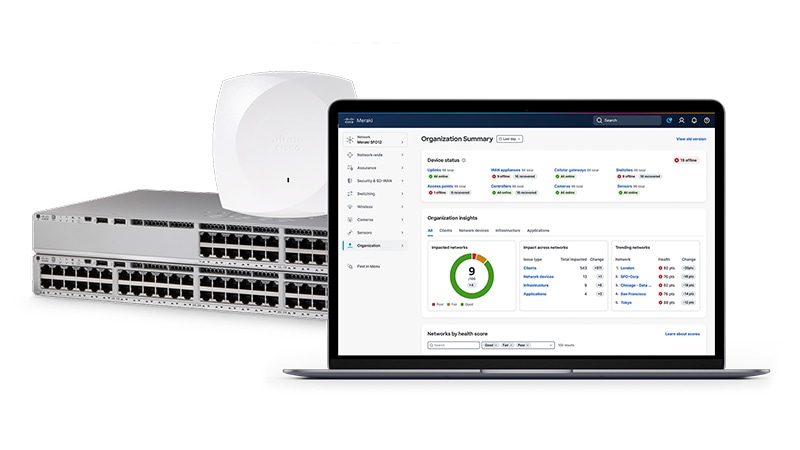
- Meraki for distributed environments. For organisations managing multiple sites — regional offices, branches, retail locations — Cisco Meraki's cloud-managed switching and wireless removes the operational overhead of per-device CLI management. Configuration changes propagate from a dashboard, and visibility across all sites is centralised.
- Ecosystem certifications. Philippine enterprises pursuing ISO 27001, PCI DSS, or BSP-mandated network segmentation find that auditors are most familiar with Cisco's security feature sets. Documentation and compliance tooling are more mature than alternatives.
Where to be careful: Cisco's licensing model — particularly Catalyst Center and Smart Net — adds significant cost beyond hardware. For organisations in the 100–500 user range, the total cost of a fully featured Cisco deployment can be difficult to justify when the same connectivity requirement can be met at lower cost. Meraki's subscription-based licensing creates a recurring cost that persists for the life of the hardware.
Best fit: Large enterprise and regulated sectors (banking, telco, government); distributed organisations that value centralised cloud management; environments where Cisco certifications reduce audit friction.

Fortinet: Security-First Networking
Fortinet's network strategy is built around the Security Fabric — a tightly integrated platform where firewalls, switches, wireless access points, and SD-WAN are managed through a single FortiManager console. For Philippine organisations where the IT team is small and the threat surface is large, this consolidation has real operational value.
What Fortinet does well:
- Integrated security posture. A FortiGate firewall, FortiSwitch access layer, and FortiAP wireless infrastructure share policy enforcement. An endpoint that misbehaves on the wireless network can be isolated through the same console that manages your firewall rules — without switching between systems.
- FortiOS 8.0 capabilities. The March 2026 release added AI-driven threat detection, shadow AI visibility, and post-quantum cryptography across the Security Fabric. For Philippine enterprises in BFSI and healthcare where threat detection maturity matters, this is a meaningful differentiator. See our FortiOS 8.0 breakdown for detail.
- SD-WAN for multi-site operations. FortiGate's SD-WAN features are built into the firewall — no separate SD-WAN appliance required. For Philippine organisations with branch offices in Cebu, Davao, Clark, or provincial locations where WAN reliability is variable, this simplifies multi-link failover management significantly.
- Lower TCO at mid-market scale. For organisations in the 50–500 user range, a Fortinet Security Fabric deployment consistently comes in below equivalent Cisco configurations on both hardware and licensing cost.
Where to be careful: Fortinet's switching and wireless portfolio is less mature than Cisco's for very large environments. For data center core switching at hyperscale or for environments requiring granular QoS across thousands of ports, Cisco's depth is greater. Note also that the FortiGate 100F reached end-of-sale in April 2026 — if your security appliances are due for refresh, factor this into your networking upgrade plan.
Best fit: SME to mid-market; organisations prioritising unified security management; multi-branch environments in the Philippines where SD-WAN and remote management matter; IT teams that want a single vendor for firewall, switching, and wireless.
HPE Aruba: Wireless and Campus Networking
HPE Aruba's strength is wireless-first campus networking. Where Cisco leads in wired core infrastructure and Fortinet leads in security integration, Aruba leads in high-density wireless environments and AI-driven network operations.
What HPE Aruba does well:
- High-density wireless. Aruba's 802.11ax (Wi-Fi 6/6E) access points consistently outperform alternatives in high-density environments — large BPO floors, hospital wards, university campuses, conference centers. For Philippine organisations where wireless is the primary connectivity layer rather than a supplement to wired, Aruba is the strongest technical choice.
- AIOps with Central. Aruba Central uses machine learning to automate network health monitoring, root-cause analysis, and configuration recommendations. For lean IT teams, this reduces the time spent on reactive troubleshooting.
- ClearPass Policy Management. Aruba's ClearPass provides enterprise-grade network access control — authenticating users and devices, enforcing role-based policies, and segmenting guest, corporate, and IoT traffic. For Philippine organisations with BYOD environments or mixed user populations, this is the most capable NAC platform in the mid-market.
- Integration with HPE ProLiant infrastructure. For organisations already standardised on HPE enterprise servers, Aruba extends the HPE ecosystem to the network layer with shared support contracts and validated reference architectures.
Where to be careful: Aruba's wired switching portfolio is capable but less dominant than Cisco's at the enterprise core. For organisations where wired infrastructure is the primary requirement, Aruba may require supplementing with third-party core switching. Aruba Central licensing is subscription-based — a recurring cost that needs to be built into multi-year TCO calculations.
Best fit: Wireless-first campuses; healthcare, education, and hospitality sectors; organisations with complex NAC requirements; companies in the HPE ecosystem.
The Decision Framework for Philippine Enterprises
| Requirement | Recommended Vendor |
|---|---|
| Regulated sector, large enterprise, Cisco team in-house | Cisco Catalyst / Meraki |
| Unified firewall + switching + wireless management | Fortinet Security Fabric |
| Multi-branch Philippines operations, SD-WAN priority | Fortinet FortiGate SD-WAN |
| High-density wireless campus | HPE Aruba |
| Mixed HPE server environment | HPE Aruba |
| Mid-market, budget-conscious, security-first | Fortinet |
What Philippine Buyers Often Underestimate
VLAN segmentation is not optional. Under the NPC's enforcement posture, organisations handling personal data are expected to demonstrate network-level controls. Flat networks — where a compromised endpoint can reach every other device — are a compliance finding waiting to happen. Any enterprise networking refresh should include proper VLAN design as a baseline requirement.
Out-of-band management. When a misconfiguration takes down a VLAN or a firmware update bricks a switch, you need a way to recover the device without being on-site. All three vendors support out-of-band management through dedicated management ports or cellular-connected appliances. For Philippine organisations with provincial sites, this is non-optional.
Power over Ethernet (PoE) capacity planning. IP cameras, VoIP phones, and Wi-Fi 6 access points all draw power from the switch. PoE budget — the total wattage the switch can deliver — is a specification that procurement teams frequently overlook until the access layer is installed and access points start dropping offline under load.
If you are evaluating a networking refresh, the right starting point is your environment — existing stack, team certifications, and workload profile — not the vendor shortlist.
Talk to our I.T. Hardware team →