Brownouts Outside Metro Manila: How Philippine Provincial Offices Should Size Their UPS and Power Protection

Philippine businesses outside Metro Manila face a different power environment than the capital region. The data from the Department of Energy's distribution utility performance reports is consistent: provincial distribution utilities — particularly in Visayas and Mindanao — report higher interruption frequency, longer average brownout duration, and wider voltage deviation ranges than Meralco's service area.
This has direct implications for power protection specifications. A UPS sized for Metro Manila conditions — where brownouts are measured in minutes and voltage quality is relatively stable — is often undersized for a Cebu City, Davao, Iloilo, or provincial Luzon office where interruptions can extend 30–120 minutes and voltage swings are wide enough to damage equipment even when power is technically "on."
The Provincial Power Problem Is Three Separate Problems
Understanding the three failure modes is important because they require different protection approaches.
1. Power Interruptions (Brownouts and Outages)
A complete loss of power. Server, NAS, switches, IP PBX, and workstations shut off instantly without UPS protection. Data corruption, hardware damage from abrupt shutdown, and operational disruption.
Metro Manila: Short-duration events (typically under 10 minutes) are most common. Longer events occur but are less frequent.
Provincial: Distribution utilities serving provincial areas report SAIDI (System Average Interruption Duration Index) figures that are meaningfully higher than Meralco's. For areas served by electric cooperatives rather than private distribution utilities, SAIDI can run 2–5× higher than Metro Manila. Events of 30–120 minutes duration are operationally significant enough that standard 7–10Ah UPS battery runtimes are insufficient.
2. Voltage Fluctuations and Sags
Voltage drops that do not result in complete interruption but are severe enough to cause equipment malfunction. Computers blue-screen, servers reset, IP PBX drops calls, network switches cycle. The power is technically "on" but the voltage is unstable.
Provincial context: Load imbalances, long distribution lines, and ageing transformer infrastructure in provincial areas create wider voltage swings than Metro Manila. Voltage sags to 180V or below — damaging to sensitive electronics — are more common outside the capital region.
Protection: Online double-conversion UPS provides complete isolation from the input voltage and synthesises a clean output regardless of input quality. This is the appropriate UPS type for any environment with significant voltage fluctuation — not just for brownout protection.
3. Power Surges
Voltage spikes above rated levels, often at the moment power is restored after a brownout. Equipment directly connected to mains at restoration can see transient voltages that destroy power supplies.
Protection: Online double-conversion UPS also handles surges — input power is rectified and inverted regardless of transient events on the input side. Surge-only protection (basic surge strips) does not address brownouts or sags. For a clear breakdown of what surge protectors cannot do, see Surge Protector vs UPS: Why Philippine Offices Confuse Them.
The Standard Sizing Formula (and Why Provincial Offices Need to Modify It)
The standard UPS sizing formula:
Required UPS capacity (VA) = Total load (W) ÷ Power factor × 1.25 safety margin
For a standard office UPS with 0.8 power factor: Required VA = Total W × 1.25 ÷ 0.8 = Total W × 1.5625
This formula is correct for all environments. The provincial-specific adjustment is in runtime — the battery capacity required to ride out the brownout.
Metro Manila assumption: 10–15 minutes runtime is sufficient for most events. Standard internal battery packs in most UPS units are rated for 5–15 minutes at full load.
Provincial adjustment: For areas where interruption events regularly exceed 20 minutes, the standard internal battery is insufficient. Options:
- Long Run UPS variants — UPS models with extended battery packs built in, providing 30–60+ minutes at typical office loads. PROLINK's Professional II Series Long Run variants fall into this category.
- External battery pack (EBP) expansion — Many online double-conversion UPS units support external battery pack connection. Each EBP adds 30–60 minutes of additional runtime depending on load.
- Larger UPS with expanded runtime — Sizing up to the next capacity tier and running at 50–60% of rated capacity extends battery runtime relative to load.
Recommended Specifications for Provincial Philippine Offices
Small Provincial Office (switches, NAS, IP PBX, 3–5 workstations)
Typical load: 1,500–2,500W
Standard UPS capacity: 3 kVA online double-conversion
Provincial adjustment: Specify Long Run variant with minimum 30 minutes runtime at full load
Monitoring: Picobox REX connected to UPS for remote power status monitoring — critical for provincial locations without on-site IT staff
Medium Provincial Office (server room with 1–2 rack servers, NAS, networking)
Typical load: 3,000–6,000W
Standard UPS capacity: 6 kVA online double-conversion
Provincial adjustment: Long Run variant or external battery pack for 45–60 minute runtime. Verify that the UPS supports EBP expansion before purchase.
AVR: Integral in online double-conversion UPS — no separate AVR needed
Larger Provincial Office or Branch with Server Room (3+ rack servers, full network infrastructure)
Typical load: 6,000–15,000W
Standard UPS capacity: 10 kVA online double-conversion, potentially with tower or rack-mount options
Provincial adjustment: External battery pack expansion for extended runtime; consider diesel generator as a complement for events exceeding 2–3 hours
Monitoring: Facility monitoring via Picobox REX or FMGUARD with SMS/email alerts configured for battery low, power fail, and overload events
The Generator Question
For provincial offices experiencing interruptions that regularly exceed 60 minutes, a UPS alone is not sufficient infrastructure. The UPS protects against short-to-medium events and provides clean power during generator startup; the generator handles extended events. See Generator + UPS Integration for Philippine Offices for the correct architecture and common integration mistakes.
The correct architecture:
- Power fails
- UPS immediately takes over (zero-millisecond transition for online double-conversion)
- Generator starts within 10–30 seconds
- Load transfers to generator (UPS continues providing conditioned output)
- UPS battery recharges while generator runs
- Power restores → load transfers back to mains → UPS resumes normal operation
UPS and generator sizing must be compatible: the UPS must be able to accept generator power (some generators produce power quality that older offline or line-interactive UPS units handle poorly; online double-conversion is generator-compatible by design).
For provincial operations without generator infrastructure, the practical interim solution is a Long Run UPS with external battery packs configured for the longest routine brownout duration in the area — typically 60–120 minutes for the most affected provincial locations.
Voltage Quality Protection: Why AVR Alone Is Not Enough
A common configuration in provincial offices is a standalone AVR with basic UPS backup. This addresses voltage fluctuation (the AVR stabilises voltage within its operating range) but does not provide full protection:
- AVRs do not provide surge protection beyond their rated surge capacity
- Offline UPS (the cheapest category, sometimes called standby UPS) has a transfer time of 4–8ms — sufficient for most equipment but potentially problematic for sensitive network equipment and servers
- Line-interactive UPS provides better voltage regulation but still transfers to battery on full interruption
The correct specification for provincial Philippine offices is online double-conversion — the UPS synthesises clean output continuously, with no transfer time, complete surge isolation, and full voltage regulation regardless of input quality. The AVR function is built in. There is no separate transfer on interruption. For any environment where power quality is an operational concern, this is the appropriate specification. For a deeper look at why a standalone AVR cannot substitute for a UPS, see Voltage Regulation in the Philippines: Why an AVR Is Not Enough.
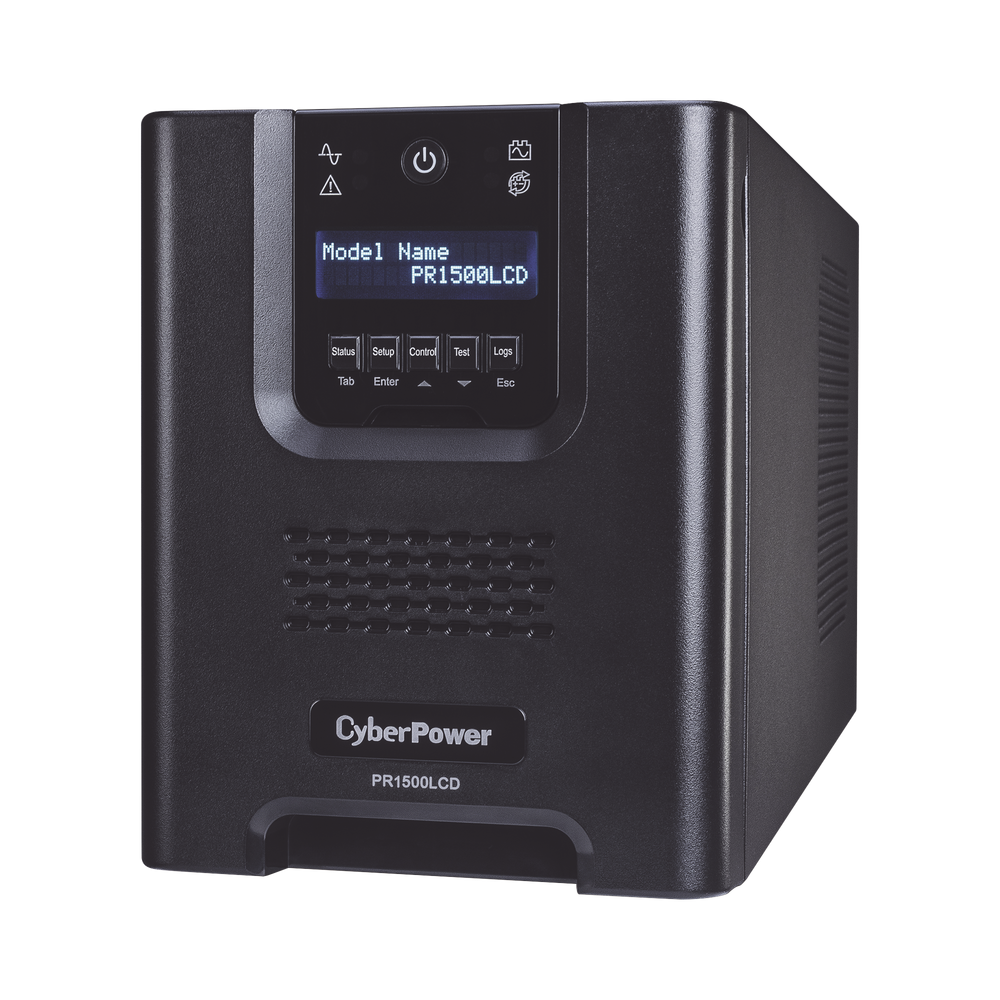
PROLINK's Professional II Series (1–10 kVA) is online double-conversion throughout the range and is the appropriate specification for Philippine office environments up to approximately 8 kW of real load. The Long Run variants are specifically designed for the extended runtime requirements of provincial deployments.
Facility Monitoring for Provincial Locations
Provincial offices often operate without full-time on-site IT staff. When a power event occurs overnight or on a weekend, no one may be aware until staff arrive and find equipment shut down, data corrupted, or cooling failed.
Picobox REX and FMGUARD provide remote facility monitoring with SMS and email alerts for:
- Power failure (mains loss detected)
- UPS battery low or on battery
- Temperature threshold breach (relevant when air conditioning fails during a brownout)
- UPS overload
For provincial operations with remote sites, this monitoring capability is not optional — it is the difference between knowing about a power event in real time and discovering it hours later.
If you are specifying power protection for a provincial Philippine office or branch location, get in touch.
Related reading: Generator + UPS Integration for Philippine Offices · AVR vs UPS: Why an AVR Is Not Enough for Servers · Facility Power Monitoring in the Philippines
Talk to our Power Systems team →