AI Is Rewriting Data Centre Power Requirements. What Philippine Server Rooms Actually Need to Know.

The power requirements for AI data centre infrastructure have crossed a threshold that makes most existing server room designs — built for standard enterprise workloads — inadequate for the newest AI hardware. The numbers are confirmed, not projected: a single NVIDIA GB200 NVL72 rack draws between 120 and 140 kW. The traditional enterprise server room was designed for 10–15 kW per rack.
This is not a problem facing most Philippine businesses today. But the trends reshaping large-scale data centres — higher rack densities, liquid cooling mandates, UPS architecture shifts — are beginning to trickle into enterprise server room planning, and understanding the distinction between hyperscale AI infrastructure and standard enterprise deployments is increasingly necessary.
What Is Actually Happening at the Rack Level
GPU Power Progression
GPU power consumption has increased in a nearly straight line since AI workloads became the dominant driver of server hardware procurement:
| Period | GPU Typical Power Draw |
|---|---|
| Until 2022 | ~400W per GPU |
| 2023 | ~700W per GPU |
| 2024 (Blackwell generation) | ~1,200W per GPU |
| Next generation | 1,400W+ per GPU |
A standard AI server blade carries eight GPUs. Ten blades per rack produces a rack-level draw of 80 kW or more for Blackwell-generation systems. The NVIDIA GB200 NVL72 — Google confirmed it will offer this system; Dell's XE9812 and HPE's Vera Rubin NVL72 ship in H2 2026 — draws 120–140 kW per rack.
Vertiv, a major UPS and power infrastructure manufacturer, projects that AI rack-level power density will increase from 50 kW per rack (2024) to 1 MW per rack by 2029.
Cooling Follows Power
Air cooling supports approximately 20 kW per rack at standard ambient temperatures. Liquid cooling (direct-to-chip) supports up to 100 kW per rack. Immersion cooling supports 200+ kW per rack with near-1.0 power usage effectiveness (PUE).
Liquid cooling is no longer optional for GB200 NVL72 deployments. At Data Center World 2026, Google infrastructure engineering lead Sakalkar stated: "Liquid cooling is here. At this point, the conversation is about standardisation." The technical gap between air cooling capacity (20 kW) and the latest AI rack requirements (120–140 kW) makes this a hard engineering constraint, not a preference.
Facilities deploying Blackwell-generation hardware must install direct-to-chip liquid cooling infrastructure: coolant distribution units (CDUs), leak detection systems, and compatible rack designs. None of this exists in a standard enterprise server room. For the full picture on Philippine server room cooling requirements, see Data Centre Cooling in the Philippines.
UPS Architecture Is Changing
Traditional centralised AC UPS systems — the architecture found in most Philippine enterprise server rooms — were designed for rack loads of 10–15 kW. AI infrastructure at 80–140 kW per rack creates several problems for this architecture:
- Insufficient rated capacity per distribution path
- High energy losses from multiple AC-to-DC and DC-to-AC conversion stages at scale
- Inability to respond quickly enough to the sharp, dynamic load patterns that GPU clusters create during training runs
Industry assessments at Data Center World 2026 confirmed that AI training clusters create load fluctuations visible "all the way back at the power plant" — not just within the data centre. NVIDIA's James noted that on-site generation is being used as a stopgap but "is not the preferred long-term solution."
For very large AI deployments, medium-voltage (MV) UPS systems — operating between 1,000V and 35 kV — are replacing traditional low-voltage centralised UPS setups. Lithium-ion batteries are replacing lead-acid across all tiers of the market, delivering faster charging, higher power density, and longer service life.
Goldman Sachs Research projects that data centre power demand will grow 160% by 2030, driven primarily by AI workloads.
What This Means for Philippine Office and Enterprise Server Rooms
The numbers above describe hyperscale AI infrastructure. A Philippine office server room — running standard virtualisation, file serving, database, and line-of-business applications — does not face these constraints today.
Standard enterprise server loads have not changed. A 1U or 2U rack server running standard workloads draws 200–750W. A 10-person server room with two rack servers, a NAS, a switch, and an IP PBX system draws 1,000–1,500W total. This has not changed because of AI announcements. The power, cooling, and UPS sizing guidance for standard enterprise environments remains exactly as it was.
The thresholds that matter for Philippine SMEs:
| Server Room Type | Typical Load | UPS Recommendation |
|---|---|---|
| Small office (switches, NAS, IP PBX) | 0.5–2 kW | 1–2 kVA online double-conversion |
| Standard server room (1–3 rack servers) | 2–6 kW | 3–6 kVA online double-conversion |
| Mid-size server room (multiple racks, standard workloads) | 6–15 kW | 6–10 kVA online double-conversion |
| AI inference node added to existing server room | +4–8 kW per GPU server | Resize UPS accordingly — see below |
If you are adding GPU-based inference hardware, resizing your UPS is not optional. This is where the AI rack power trends become directly relevant to Philippine SMEs. A single GPU inference server — even a single-GPU configuration for local AI model inference — adds 300–800W of draw that was not in your original UPS sizing. Multiple GPU nodes at 1,200W each on a circuit designed for standard server loads will trip protection systems or run the UPS beyond its rated capacity.
The correct process: recalculate total load including all new GPU hardware, apply the standard formula (total W × 1.25 ÷ 0.8), and verify that your existing UPS capacity and battery runtime remain within the 60–70% optimal operating range. If the new load pushes the UPS above 85% of rated capacity, size up before the hardware arrives. For the full sizing walkthrough, see How to Size a UPS for Your Philippine Office or Server Room.
Liquid cooling is not required for standard enterprise GPU inference nodes. The liquid cooling mandate applies to configurations like the GB200 NVL72 at 120–140 kW per rack. A single GPU inference card in a standard rack server is still air-cooled and compatible with existing server room ventilation, provided rack airflow clearances are maintained.
UPS Considerations for Philippine Server Rooms Adding AI Hardware
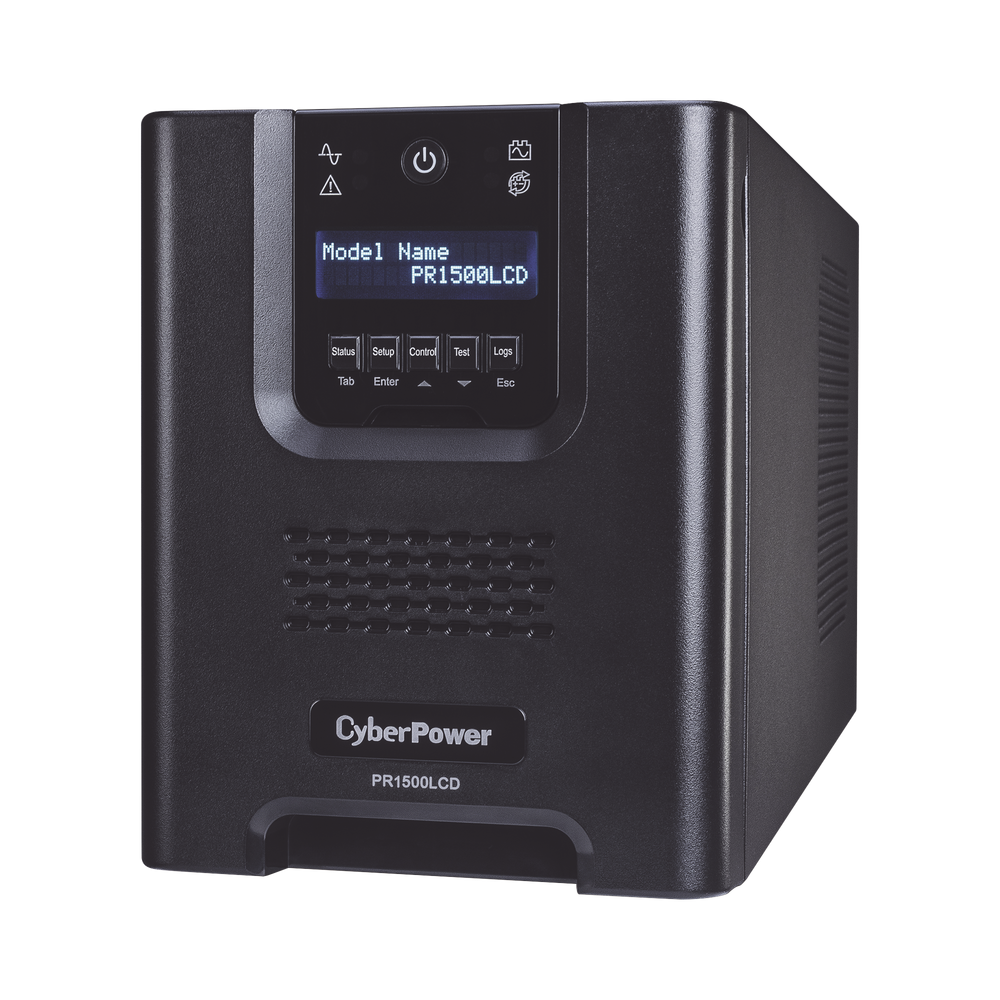
Prolink's Professional II Series — online double-conversion, 1–10 kVA — covers the full range of standard Philippine enterprise server rooms and remains the appropriate specification for environments up to approximately 8 kW of real load. For Philippine offices adding GPU inference capacity:
- 1–3 kVA range (Prolink Professional II Series): appropriate for single-server deployments with one GPU card at 300–600W draw
- 6 kVA (Prolink Professional II Series): appropriate for a small server room adding a 4-GPU inference node at 1,200–2,400W total GPU draw alongside existing infrastructure
- 10 kVA (Prolink Professional II Series): appropriate for heavier mixed loads approaching 8 kW after accounting for GPU and standard server load
For Philippine provincial locations where brownout duration regularly exceeds 20 minutes, the Long Run variants with extended battery capacity remain the appropriate choice regardless of whether AI hardware is being added.
The structural shift at hyperscale — to MV UPS, liquid cooling, and direct-to-chip power distribution — is real and significant for large-scale AI deployments. For Philippine enterprise server rooms, the immediate implication is simpler: if you are adding GPU hardware, recalculate your load and verify your UPS is still appropriately sized before going live.
If you need help sizing a UPS for a Philippine office or server room — including environments being upgraded with GPU-based inference hardware — get in touch.
Related reading: How to Size a UPS for Your Philippine Office or Server Room · Data Centre Cooling in the Philippines · UPS for Philippine Data Centres
Talk to our Power Systems team →